Philippe Parreno transforms Gladstone Gallery into a shifting environment of light, movement, and perception with “Noor,“ a new exhibition that places illumination at the center of the artist’s evolving practice. Long recognized for treating exhibitions themselves as living systems rather than static displays, Parreno once again constructs a space where objects, images, sound, and architecture behave less like isolated artworks and more like interconnected presences responding to one another in real time.
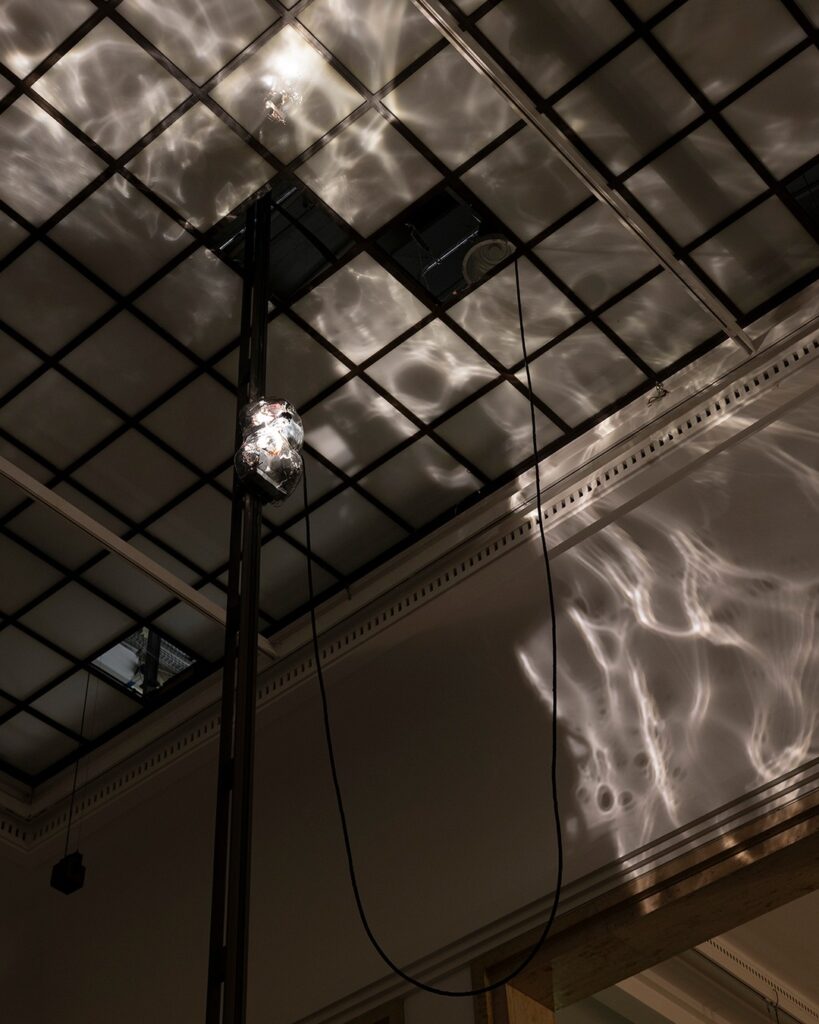
For decades, light has operated as a recurring material throughout Parreno’s work, from his glowing marquees and luminous projections to sculptural lighting elements that appear throughout his installations like active performers within a larger choreography. In “Noor,“ however, light becomes the exhibition’s primary structural force, shaping atmosphere, rhythm, and the relationships between all elements within the space.
The title derives from the Arabic and Persian word for “light,” referencing the philosophy of the 12th-century Persian mystic Shihab al-Din Yahya Suhrawardi, whose cosmology imagined existence as an emanation flowing outward from a supreme “Light of Lights.” Parreno draws upon this metaphysical framework to construct an exhibition where illumination operates not only physically, but conceptually, as something capable of linking matter, thought, memory, and perception.
At the center of the exhibition is “In the Moontime”, a newly premiered animated work connected to Parreno’s recent feature film “River.” The piece combines still and moving drawings organized into constantly shifting visual sequences generated through John Horton Conway’s famous computational model, “The Game of Life”. Using a system of evolving digital “cells” that switch between active and inactive states according to mathematical rules, the animation continuously rearranges images into new relationships and fleeting narratives.
Rather than unfolding linearly, the work behaves more like an unstable visual ecosystem. Images belonging to recurring thematic groups, insects, architecture, water, light, figures, matter, and cosmic forms, appear and disappear across the screen in endlessly changing combinations. Meaning emerges momentarily through proximity rather than traditional storytelling: a staircase beside a body of water, an insect next to a moonlit landscape, fragments of movement suspended within larger cycles of repetition and transformation.
Throughout “Noor,“ Parreno continues his long-standing interest in time as something fluid, cyclical, and unstable. Instead of directing viewers through a fixed sequence of events, the exhibition unfolds according to shifting rhythms generated through algorithms, light changes, and spatial interactions. The experience feels less like moving through a conventional exhibition and more like entering an environment that remains subtly alive and constantly reorganizing itself.
Conceived as a tribute to the late Barbara Gladstone, “Noor” also carries a quiet emotional dimension beneath its technological and philosophical complexity. Light, shadows, reflections, and suspended atmospheres become both material and metaphor, a way of thinking about presence, memory, and the fragile relationships between objects, spaces, and those who move through them.
With “Noor,“ Philippe Parreno once again expands the possibilities of what an exhibition can be, treating the gallery not as a container for artworks, but as a responsive, temporal organism shaped by perception, movement, and the constant instability of experience itself.
Opening May 13, 6 – 8pm / New York: 21st Street
Philippe Parreno online:
Instagram
Gladstone Gallery online:
Website
Instagram
Photo: (c) Andrea Rossetti