A dress that can clean itself, renew its surface and repair small tears without thread or adhesive sounds like speculative fashion. Researchers in China have now brought the idea into the laboratory, using living mycelium to create a textile that remains biologically active after fabrication.
Developed by a team at the Shenzhen Institutes of Advanced Technology, the material belongs to a growing field known as engineered living materials (ELMs); structures made with living organisms that retain some of their biological functions once they have been shaped into a usable material.
The researchers worked with Cordyceps militaris, keeping the fungus dormant rather than killing it during production. This distinction is central to the project. Most mycelium-based materials currently used in packaging, interiors and other applications are dried until the organism is no longer biologically active. Here, the fungal network remains capable of responding to its surroundings.
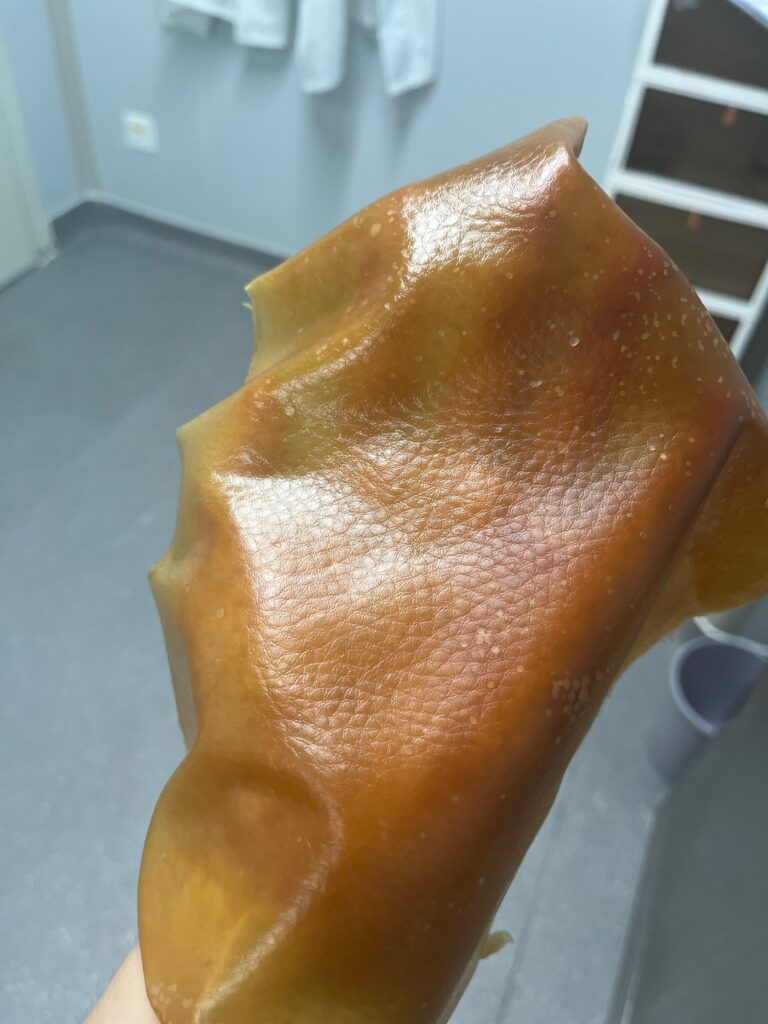
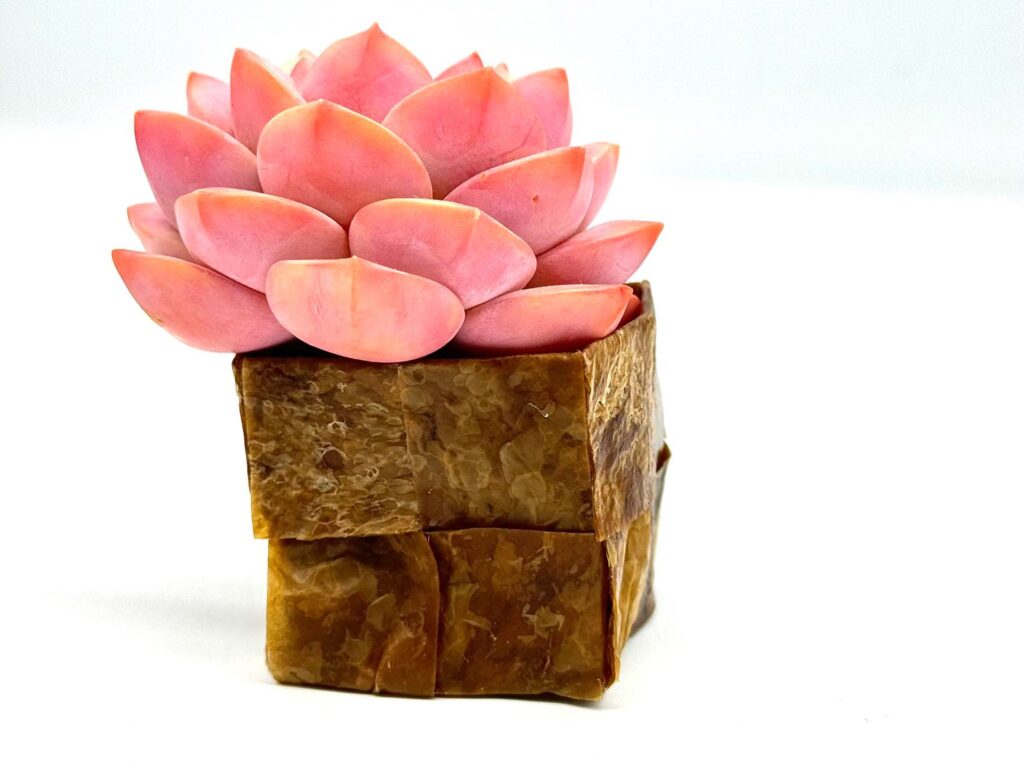
The resulting textile acts as a programmable base that can be given additional properties through other fungi or yeasts. The researchers describe the approach as a “plug-and-play” biological platform, with different organisms contributing functions such as pigmentation or UV protection.
Its ability to renew itself comes from the dormant mycelium embedded throughout the material. After being dried at around 45°C, the textile enters what researcher Ke Li describes as a low-metabolic, dormant-like state. It is not actively growing, but the biological system remains capable of being reactivated.
That can happen with a nutrient solution made from potato water. Once introduced to the material, the dormant mycelium begins producing new fungal filaments, allowing the surface to regenerate.
The same process can be used to repair damage. When the nutrient solution is applied around a hole together with a small amount of fresh fungus, new growth spreads across the opening and reconnects the material. There is no stitching, glue or conventional patching involved.
The textile also has an unusual property that requires no additional biological intervention: it is naturally hydrophobic, giving it a degree of self-cleaning behaviour.
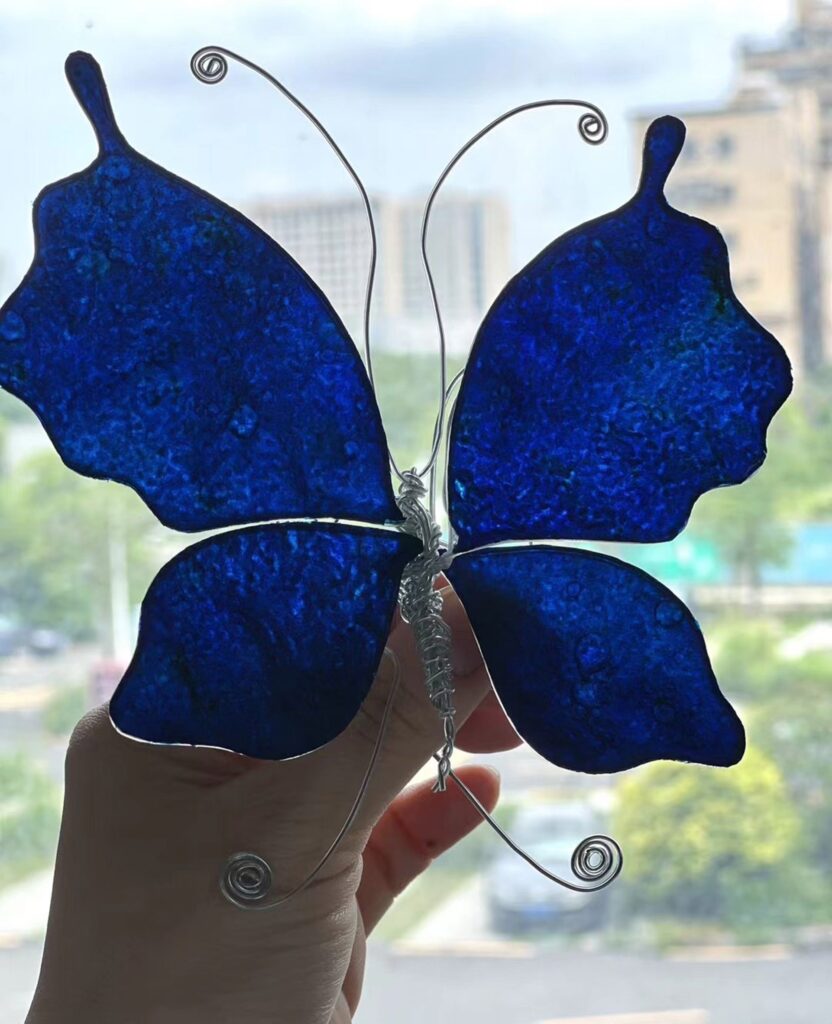
Other organisms can be incorporated during production to alter the material’s appearance or performance. Brewer’s yeast (Saccharomyces cerevisiae) produces a deep blue pigmentation, while Aspergillus niger contributes UV resistance. Because the organisms are simply co-cultured with the Cordyceps militaris, the researchers achieved these functions without genetic engineering.
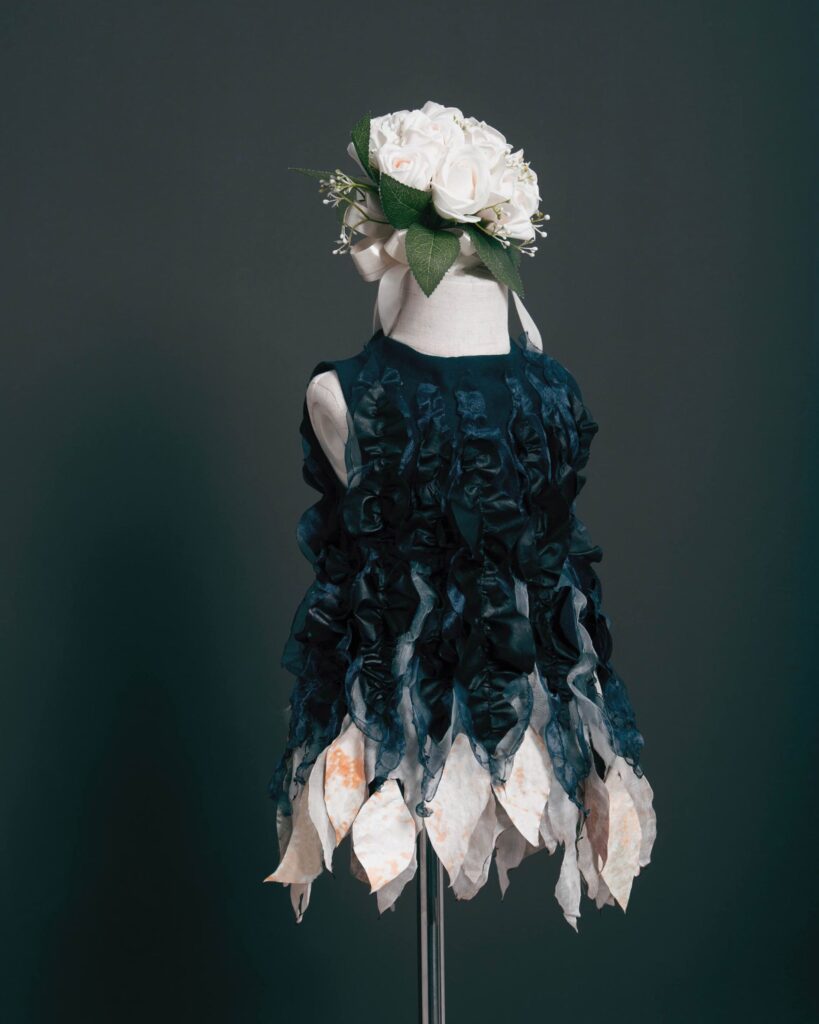
To demonstrate what the material might mean outside the laboratory, the team collaborated with Berlin-based material innovation company Peelshere on a prototype garment. Founder YouYang Song developed the conceptual and visual direction, while Ruochen Wang handled the cutting and construction.
The resulting dress incorporates several variations of the fungal textile, including sections grown with brewer’s yeast to produce its characteristic blue colour.
What makes the project particularly interesting is that the material is not simply made from fungi. The organism remains part of the material’s behaviour. It can reactivate, grow, renew and alter its own surface under the right conditions.
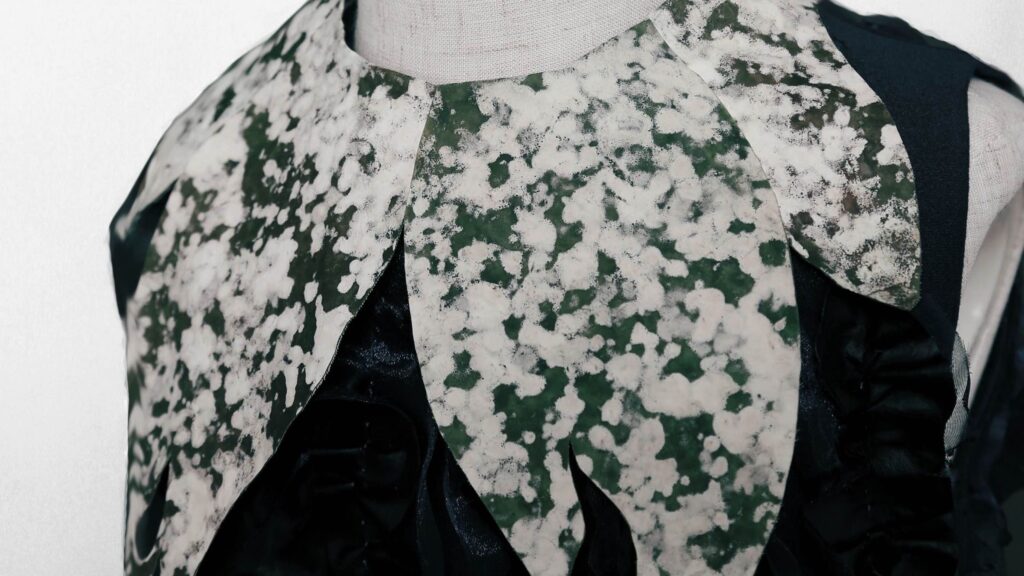
That places the research somewhere between biotechnology, material science and fashion, where a textile is no longer an entirely finished object but a biological system with the capacity to continue changing after it leaves the production line.
Photo: (c) Ke Li