Wallace Woo has been talking about stalactites for years, but not as metaphor. It’s closer to a working method. Each canvas builds the way rock does: pressure, sediment, time, no shortcuts, and the Paris-based artist has stayed committed to that pace even as the art world around him keeps accelerating.
He calls the practice geological abstractionism. In this interview, he talks about architecture, his skepticism of AI-generated imagery, what failure actually means to him as an artist, and why he’d rather leave a painting unexplained than turn it into a story for people to consume.
Geological abstractionism positions painting almost as an act of excavation. Are you uncovering something that already exists, or constructing something entirely new?
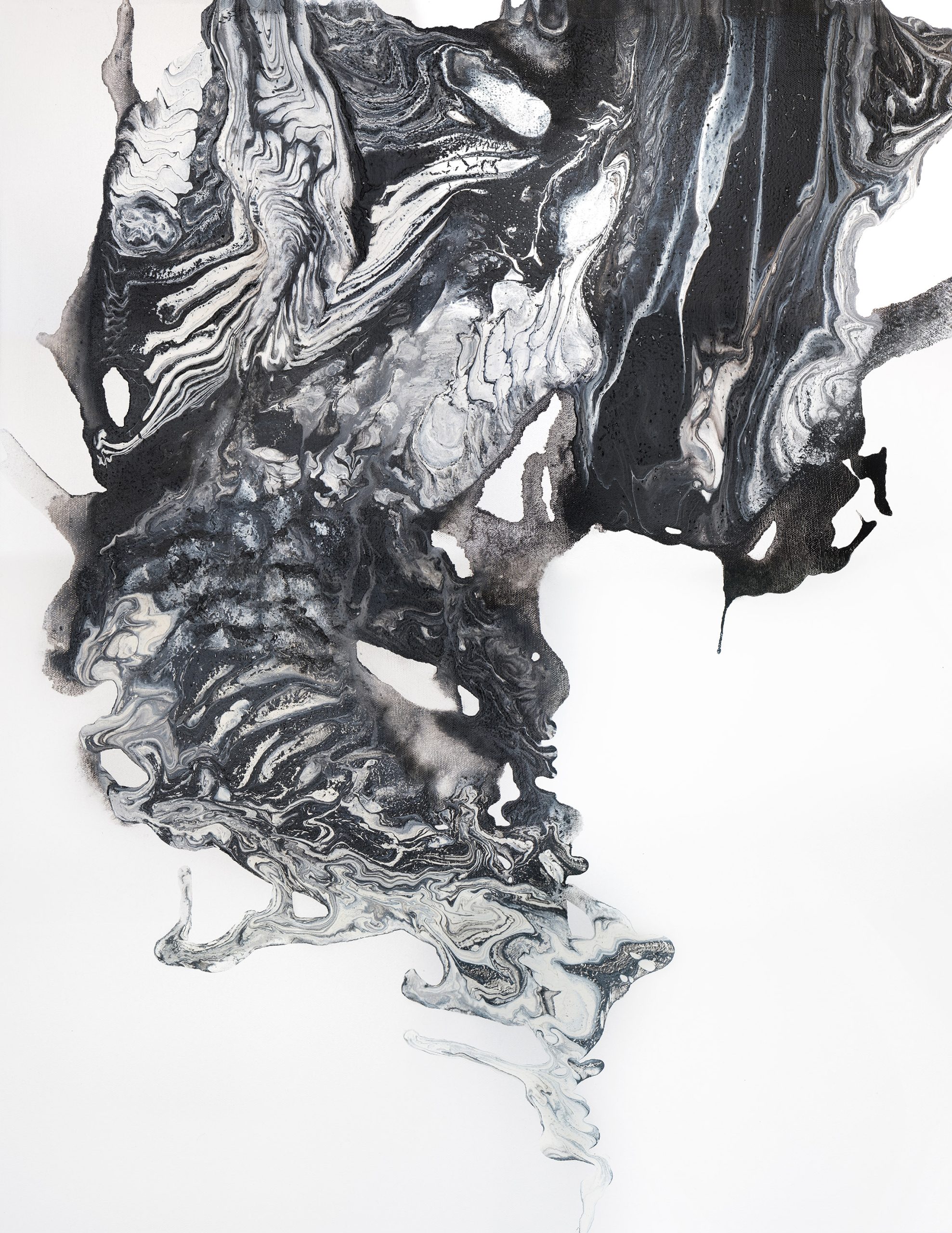
Geological Abstractionism is vast in its dimensions, and one of its core purposes is to excavate that “other self” which we cannot avoid, yet are unwilling to face, the one hidden deep within. I never deliberately set out to reveal anything, because those things have always been there, it is just that we, in our busyness, have grown accustomed to forgetting. It is only when pain arrives that we instinctively reach for something to heal ourselves. And my practice is to take that core philosophy of “stalactite aesthetics” and reconstruct it upon the canvas.
For me, I am creating something that people “already know, but have never truly encountered.” This may sound contradictory, but it has always existed within you, buried by years, by rhythm, by fear. So, I turn painting into a vessel, allowing the public to feel this force as it truly is.
Many people in this world do not enjoy meditation, because it is too arduous. Many wish to escape suffering, yet are unwilling to pay the price, and so they continue to sink into emptiness. The reason this theory feels so “substantial” is not because it carries some grand academic ideology, but because it speaks of something utterly simple: the act of letting go, as it is.
First, letting go of the urgent pursuit of “results.” I choose to let my works sediment slowly, like stalactites. This resistance to “instant gratification” allows me to let go of my attachment to immediate market feedback and instead embrace the almost “ascetic” reality of the creative process.
Second, letting go of the need to “define.” I do not wish to construct an unassailable authority through dense academic jargon. Instead, I return art to its purest form of observation and dialogue, giving viewers the space to release their own noise when confronting the work.
Finally, letting go of the excessive performance of “self.” Unlike traditional abstract painting, which often foregrounds the artist’s personal emotions, my geological perspective withdraws the self, allowing time and material forces to act upon the canvas. I hope that viewers, when facing the work, can release their attachment to ego and instead sense those scales far older and more stable than human civilization.
Yet in this age of seduction and calculation, this simple act of “letting go” often feels more luxurious than any complex philosophical system. And how many people are truly capable of doing it? Here, art no longer plays the role of pleasing the viewer’s eye, it becomes a form of “symbiosis” with the observer. When people stand before a painting, what they excavate is not the thickness of pigment, but the layered oppressions within their own hearts.
I persist in this geological creative system because I know deeply: without undergoing the “suffering and waiting” that resembles the compression of rock strata, we can never produce true crystallization. The process is painful, but we must face it as it is. We all seek shortcuts and understanding in life, yet true power often hides in the darkness where no one is willing to linger. This is not a discussion about painting, it is an experiment in “how we coexist with ourselves.” When the viewer begins to learn, before the canvas, to face their own silence, only then is the excavation truly complete.
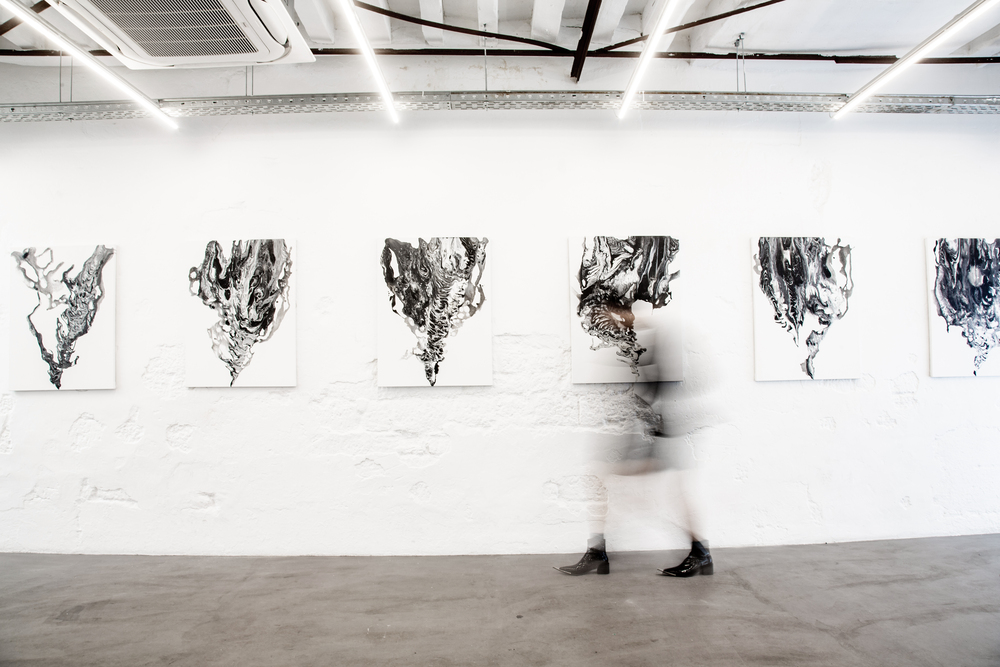
Architecture keeps appearing as a reference point in contemporary painting and Aesthive covers both. Do you think painters and architects are solving the same problem right now?
For a long time, people have understood the intersection of architecture and painting through the lens of medium or space. But I believe what truly connects them is not form; it is their response to a shared contemporary crisis. If architects are dealing with the order of space, and painters are dealing with the dimensions of the flat surface, then what we are both confronting is actually the same core question: how do we reclaim the “weight of existence” in an age saturated with information and sensory fragmentation?
Architecture and painting do frequently cross-reference each other, but this is not mere visual imitation, it is a resonance of anxiety. Contemporary architecture tends to pursue transparency, lightness, even extreme virtualization; contemporary painting similarly faces the crisis of being drowned out by “visual fast food.” As an artist, I am accustomed to analyzing the relationship between the two from both perspectives simultaneously. What I call “Geological Abstractionism” is precisely a reaction against this prevailing lightness.
When architects consider how to make space more efficient and functional, painters often think about how to make the image “heavy.” The weight I refer to here has never been physical mass, it is the sedimentation of time, and that ineffable entanglement within the human heart. We are both trying to build a wall, a wall that allows people to stop, to take a deep breath, and to find a psychological anchor in an accelerating world.
That wall, ultimately, is a boundary for self-dialogue. For the artist, it is the layers on the canvas; for the architect, it is the thickness of space. When we strip away all functional embellishments and return to the purest psychological substance, you realize that the ultimate goal of both is the same: we are trying to solidify the “fleeting present” into something that can transcend time, a legacy that offers those who encounter it a long-lost sense of stillness and dignity.
As for how stalactite aesthetics and Geological Abstractionism integrate into life, I believe this should not be seen merely as a creative method, but as a reshaping of one’s state of mind. The answer does not lie in how you “apply” this concept to your work, but in how you “see” the world with a grounded, composed disposition.
When you have sorted out your inner emotions and returned to your desk, that geological stability becomes the foundation of all your actions. Whether you are an architect, a doctor, an actor, or any other professional, once you possess this “geologized” psychological substance, your perception of your own craft will undergo a qualitative leap.
I have always believed that those who are truly formidable are powerful because they internalize diverse expertise as part of their soul. Painters do not necessarily know architecture, and architects do not necessarily paint—but we can all reference each other’s perspectives, and the only link between them is “human psychological substance.”
If you can process the noise within, and allow yourself to transform under pressure like a rock stratum, then whatever tool you hold, whether a scalpel, a script, an AI, or a paintbrush, the results you produce will carry an unshakeable sense of reality. We are all addressing the same problem: resisting the restlessness of this era, and striving to prove that humanity, in the river of time, is not mere foam drifting with the current, but agents capable of creating hardened strata. When we finally set down our tools, what we leave to the world will be those marks that have been tempered by time and engraved into the soul.
Your work operates on a timescale that resists the 24-hour content cycle. How do you protect that in practice, both in the studio and in how you show the work?
Facing the 24-hour content cycle, I do often feel a certain indescribable disorientation. There is a contradiction here: during exhibitions, I want my audience to put down their phones and enter what I call “cave time”, but if they don’t share images, these discussions around Geological Abstractionism struggle to reach others who might be longing for resonance. It is a constant pull between “immersion” and “diffusion,” and I am no exception, I get caught up in it too. But I believe that rather than fighting against an unchangeable environment and adding to my own distress, it is better to learn to adapt and coexist, finding the most comfortable balance within the flux.
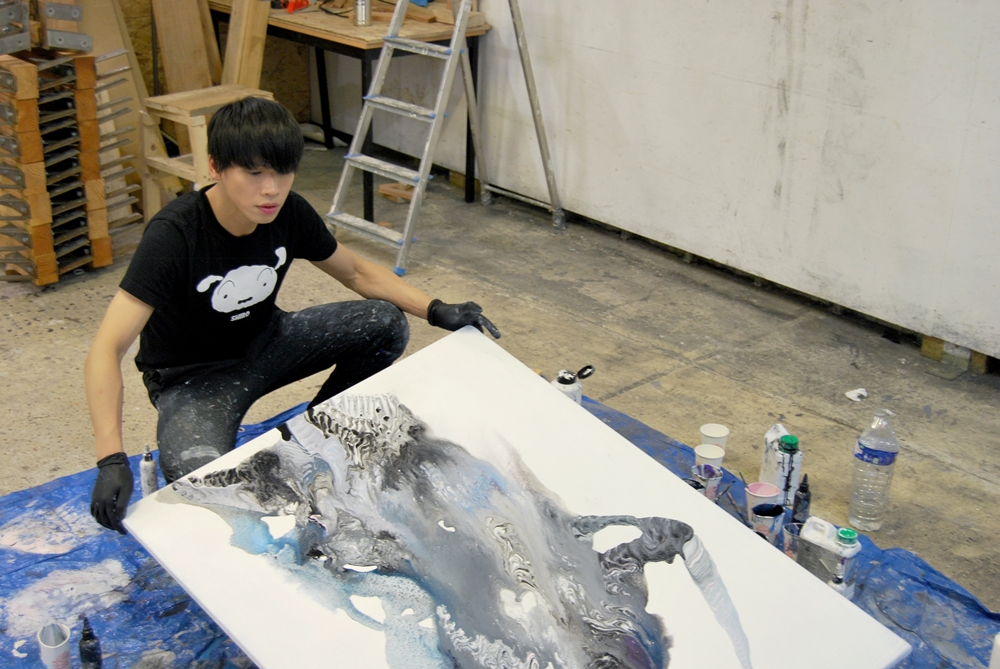
I am not averse to trends,I am actually quite enthusiastic about engaging with new things, but I know when to let go and not let myself be consumed by them. In the studio, I place myself within the dimension of “Deep Time” to create. This is not just painting; it is an “archaeology of time”, waiting for the pigment to dry, waiting for fissures to form, waiting for natural accumulative effects to emerge.
This is a process that cannot be digitized, cannot be compressed. This insistence on “slowness” is my fundamental defense against “digital nihilism,” and it is the fruit of many years of practice.
As for presentation, I treat my works as “fossils of time.” This excruciatingly slow process may not be easily decoded in the rapid scrolling of social media; but I believe that when the right person, weary from information overload, seeks a “remedy,” the answers within the work will naturally surface.
My work does not participate in this war of information consumption, it aims to become an island where the soul can temporarily dock amidst the chaos. Though even islands may disappear with tectonic shifts, that sedimentation of time surpasses the 24-hour shelf life and points toward something more enduring, a state that belongs to the depths of the human soul.
If I were to visualize this state, my work is much like Mont-Saint-Michel in France—it does not isolate itself for the sake of isolation, but rather, when the tide of information recedes, it offers people an opportunity to pause and appreciate the reality of “here and now.” Whether it eventually sinks beneath the sea or becomes a lighthouse in someone’s heart, that is a matter of fate between the work and its viewer.
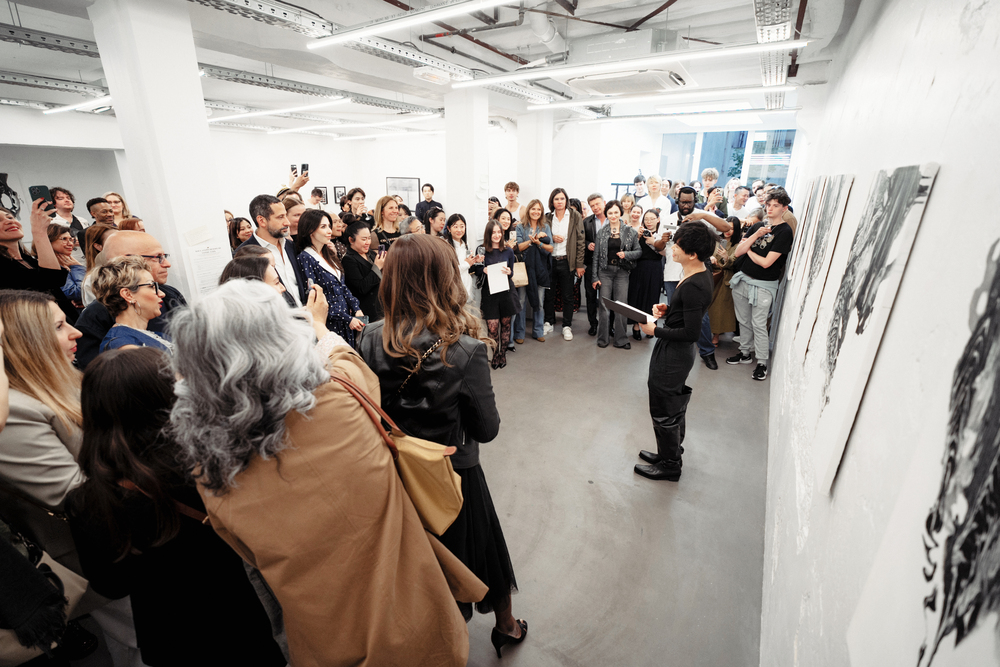
Is there a scientific field – geology, obviously, but anything else – whose way of thinking has genuinely shaped how you approach a canvas?
Many people, when discussing my work, tend to frame it as some kind of rigorous academic translation, as if I were sitting at a desk strictly applying the physical laws of geology to my painting. But what I truly want to present is a complete and independent worldview. This worldview belongs neither to the East nor to the West—it belongs to the scale of the universe itself.
Fortunately, I have never received formal scientific training. Instead, I have chosen to perceive the world directly through life itself, and this has become the most precious gift in my creative practice. Because I carry no scientific baggage, no disciplinary constraints, when I am not limited by “how science should be,” I am able, with a pure vitality, to freely touch the soul of matter.
Of course, geology is a highly illuminating window for me, I am, in a sense, “simulating” geological processes on the canvas. But the way I engage with it is not for the sake of earning a degree or writing papers; it is about, through piecing together fragments, using my body to feel that slowness spanning hundreds of millions of years. This sense of awe is less an intellectual acquisition and more a “sensorial resonance.”
What interests me is not the precise data from a scientific laboratory, but the deformation, fracturing, and sedimentation that strata undergo under tens of thousands of years of compression, simply for the sake of survival.
Rather than saying I am guided by any particular science, I would say I am more inclined to treat “feeling” as my only scientific laboratory.
If there is any way of thinking that has truly engraved itself into my canvas, it is the “truthful projection of personal emotion.” Science often pursues objective representation, whereas my art is a practice of radical, honest awareness. At the core of my creation is simply “life itself.”
How do I experience the emotions of the present moment? How do I digest the anxiety, pain, or stillness that arise from relationships and social pressures? When these feelings surge up, I do not deliberately analyze them with logic, I learn to digest those impurities with wisdom, allowing them to transform into creative energy, much like rock strata, under immense pressure, eventually crystallizing into hard minerals.
The art world has been trying to figure out what to do with AI for a few years now. Where does a practice rooted in physical, geological process sit in that conversation?
The advent of artificial intelligence is undoubtedly a massive nuclear explosion in the contemporary art world. When we consider where an artistic practice rooted in physical geological processes stands in this discussion, the image that comes to mind is that of “Zhong Wuyan” from classical Chinese literature, a guardian who is only remembered in times of crisis, while in times of calm and prosperity, people tend to chase after the dazzling and flamboyant “Xia Yingchun” style of AI-generated imagery. This absurdity of “calling on Zhong Wuyan in times of trouble, and turning to Xia Yingchun in times of peace” precisely reflects the attitude of the contemporary mainstream art market toward authentic reality.
Artificial intelligence is undeniably an inevitable tidal wave. It can generate millions of exquisite, perfectly composed, brilliantly colored images in a single second. Faced with such extreme efficiency, what puzzles me is not the art itself, but where those painters who embrace these sophisticated replication technologies are supposed to house their souls. AI printing technology can even handle architecture with precision, yet this only further exposes the dilemma of contemporary art: we have become overly obsessed with the ability to generate beautiful images, while forgetting the most primal instinct in art, that life force which cannot be coded, cannot be computed.
Recently, I observed an interesting phenomenon. A banana peel in the corner of the kitchen, gradually molding, shrinking, and decaying, revealed a kind of self-generating art. Unadorned, unmanipulated by capital, it truthfully recorded time’s erosion and transformation of matter. This forgotten banana peel and that exorbitantly priced banana taped to a gallery wall are, at their core, both bananas, yet the difference between them is immense. This is precisely the absurdity of contemporary society, and a carefully orchestrated spectacle of capitalism. The public has grown accustomed to paying for “perfect illusions,” while turning a blind eye to the real, decaying, time-laden matter right beside them.
Art rooted in geological processes is, by its very nature, a refusal of immediacy. AI is a recycling and recombination of past data, it has no memory of temperature. AI may be able to simulate the visual effect of stalactites, but a machine can never understand what it means to experience an emotional shift. When society indulges in digital nothingness, the emptiness and exhaustion of the human soul are real. Geological Abstractionism, in this context, becomes a kind of antibody. It does not compete with AI in speed, but responds with the thickness of matter and the sedimentation of time.
To be honest, I am not sure where humanity truly wishes to place this geological art practice—because under the logic of capitalism, as long as value appears, any position is possible. But that does not affect my practice. Geological evolution never sought permission from humanity; it continues to crystallize into stalactites through tens of thousands of years in the dark. This authentic contact with gravity, time, and matter is a chasm that machines can never cross.
The iteration of AI may be inevitable, but it cannot replace that primal instinct of personally participating in the reassembly of matter. When the noise of capital fades, when those AI-generated images are completely submerged by the next wave of algorithmic iteration, only those “time fossils” that have undergone gravity, waiting, and physical fracturing will remain as evidence.
This is my position, not contending, not grabbing, simply submitting quietly to the river of time, and in doing so, proving this: in a world obsessed with speed, there are still those who choose to resist nothingness with the weight of existence.
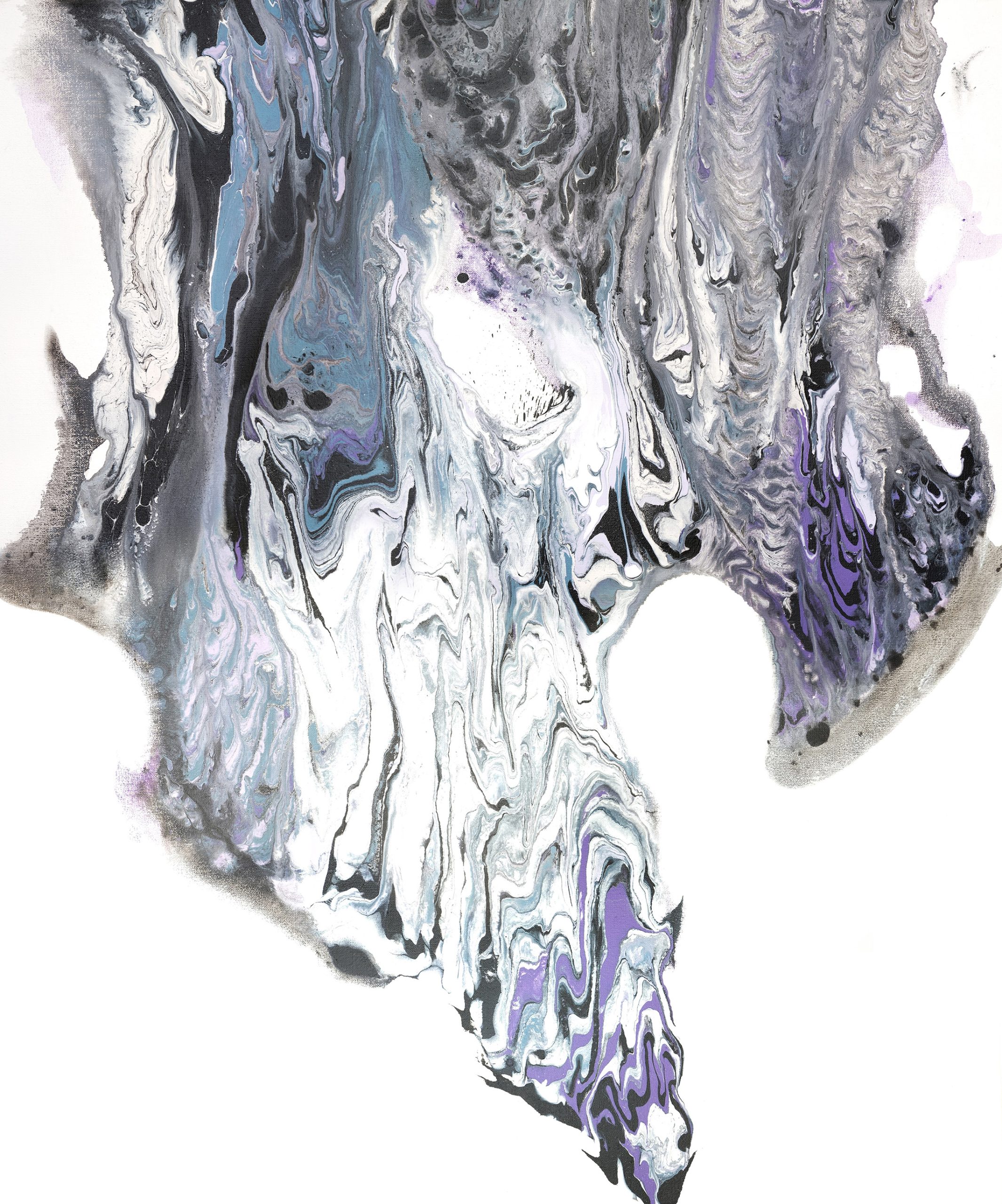
What’s a building – not a museum, not a gallery – that you think is doing something visually radical right now?
When we discuss the subversive power of architecture, we tend to be trapped by notions of “solidity” and “permanence.” But in my eyes, the most subversive “architecture” is not man-made, it is the blue ice caves of Iceland, such as Jökulsárlón or Katla. They are transient cathedrals built by glaciers and time together. They never try to please the viewer; they simply exist on their own terms, standing there with a certain aloofness.
I recall stepping into one for the first time a decade ago, the glacier was a continuous dome of ice. Returning to the same spot ten years later, although geographically the glacier appeared to have receded, psychologically the distance between myself and that pure nature felt like “so close, yet so far.”
This is a live broadcast of “vanishing.” It overturns humanity’s arrogant assumption that architecture must be “permanent,” revealing instead a dignity that ages with time, and that very process of disappearance is itself the most breathtaking visual spectacle. From another angle, it is more like an “awakening after barbarism”; we are forced to confront the destruction we have wrought upon the world, watching those ancient glaciers retreat and melt under our influence, this is the cruelest and most honest reality.
This resonates deeply with my “Geological Abstractionism”: since life and nature are so beautiful yet so fragile, I feel all the more compelled to capture and preserve that sedimentation of matter and nature before they vanish. The ice cave taught me the true meaning of architecture: it does not rush to display function or grandeur; it simply stands there in silence, as light pierces through the translucent ice, quietly manifesting the will of gravity and dissolution.
This visual subversion lies not in its splendor, but in its authentic display of “flux.” In an environment where AI pursues extreme precision and infinite replication, the ice cave, a visual marvel that could collapse at any moment, constantly changing, is undoubtedly the most profound irony. It reminds us how tedious those over-designed, instant-gratification spaces of contemporary culture can be. True spectacle often lies not in what we build, but in whether we can remain humble enough to witness how all things, in the face of time, move from magnificence to formlessness.
Do you think the concept behind a work should be legible to the viewer, or is opacity part of the point?
In the contemporary art context, “interpretation” behind a work seems to have become a standard accessory, as if without a compelling story, an artwork loses its soul. Countless artists exist in the world, and this narrative logic, which reduces creative context to consumable information, has often become the basic entry requirement into the art establishment. Yet when I stand before the canvas, the question that always surfaces in my mind is: who, exactly, holds the power to define art? And who decides that viewers must “understand” a work in a particular way?
In this age of fragmented information, the general public harbors a profound misunderstanding of art: they are accustomed to reading art like a book, demanding footnotes from the creator, insisting that the work must have clear directional meaning. But my practice runs counter to this inertial motion.
My core aesthetic “stalactite aesthetics” has as its ultimate goal the elimination of human intention. A stalactite forms through the necessity of vast time and physical sedimentation; if I were to stuff too many human labels into the work, I would disturb that deep geological stillness. Ironically, within the rules of capitalism, artistic value often depends on the monopoly of discursive power. Whoever controls interpretation defines what is “profound.” This structure of power turns art into a commodity, stripping it of its essential unpredictability.
For this reason, I am not attached to making myself “understood” by the viewer. For me, the work is merely an entrance, a fissure leading toward the unknown. What I hope the viewer reads is not my personal creative motivations, but their own forgotten feelings.
Many people fear that a work might be “obscure,” but I believe this is precisely art’s most essential resistance. What we call obscurity is, in fact, a refusal to be cheaply consumed. If a work can be seen through at a single glance, it can never become a sanctuary for the soul. When you find a work obscure, try letting go of your attachment to “understanding”, because the value of art often lies in breaking existing logic and frameworks.
The true essence of art does not lie in one-way message delivery, but in creating a space for sedimentation for the viewer. When you stop trying to explain everything, and instead resonate with the silence before the painting, the work truly detaches from my canvas and is born within your own perception.
Looking at today’s art market, whether at auction house executives or creators on short-form video platforms, they weave compelling stories like salespeople, attempting to move you through emotional manipulation. But we must ask ourselves: when you are deeply moved, is that truly your own feeling? Or is it merely a “pseudo-resonance” generated by the stories behind the artist?
If this refusal of labels means being “difficult to understand,” then I accept it willingly. Because in a world full of noise, where everyone is eager to define right and wrong, being able to quiet one person down, to face the darkness and light within themselves that they dare not confront in daily life, is the most precious crystallization of this geological excavation.
This is not a dialogue; it is an experiment in “how to coexist with oneself.” Understanding is not what matters. What matters is whether, in that moment, you allow yourself to detach from the socially defined “self” and encounter the authentic echo within. The moment that awareness arises, the purpose of art is already fulfilled.
How do you know when a painting is finished? And has that threshold shifted over time?
In my earlier years, I was trapped in the anxiety of constant revision, caught between “one more layer” and “is the fracture sufficient?” Back then, completion was a product of exhaustion and deadlines. But now, my standard has completely shifted: completion is a state of “saturated stillness.” When the layered pigments and emotions on the canvas finally arrive at a kind of “steadied balance,” the work detaches itself from my hands and takes on a life of its own.
If completion in my youth was a pursuit of “perfection,” now it is a pursuit of “truth.” I no longer try to fill every inch of space; instead, I have learned to leave breathing room within the work. I accept fissures; accept random flows, because these imperfections are slices of my real life.
This shift in standard is the art of “knowing when to let go.” When the work reaches a state where the viewer can sense the sedimentation of emotion and the expansiveness of space, I must have the resolve to stop. If I over-intervene, that natural quality of geological evolution will disappear, replaced by artifice. And this standard of completion, for me, is “honesty”, when the painting has truthfully revealed the fracture within, and no longer requires any additional covering or mending, I know it is done.
Now, I do not seek to prove my skill on the canvas. I only want to leave behind a trace of the real, a weight that offers the viewer a place to rest. When the pigment no longer speaks of my desires, but begins to speak its own silence, it has completed its farewell to me and steps independently into the world. That is the most fulfilling moment.
What would it mean for your work to fail? Not commercially, conceptually.
If you ask me what constitutes conceptual “failure,” I might have once said that it was when the work failed to convey my intention, or when the audience could not enter my logic. But now, I have a completely different definition of “failure.”
For me, artistic failure occurs when my creation degenerates into a “deliberate performance,” or when I betray the sedimented truth within myself in pursuit of so-called “beauty” or “recognition”, that is when conceptual collapse truly happens.
I have experienced countless tangible failures in my life, the pain of feeling that the path is harder for me than for others, of fighting alone against adversity late into the night. These experiences have never been obstacles; they are the fuel for my work. If my artistic journey is a geological transformation, then these failures are the immense compressive forces that force me to shed superficial expressions and search for a deeper, harder language.
I have complained about fate, and I have wept over harsh circumstances, but it is precisely these adversities that have pulled my work out of the “greenhouse of mediocrity” and thrust it into a dimension where it must contend with the universe itself.
As long as I am still creating, still feeling, still using my eyes to confront the darkness I usually dare not touch, this experiment has not failed. Whether the public understands, whether the market responds, these have become secondary within the “scale of society.” The world may not respond as I hope, but I no longer insist that it must.
The collapse of an artistic concept is not frightening; what is frightening is the stagnation of the soul. I regard those so-called failures as necessary exercises, they strip away my “attachment to self.” When I no longer live for “being understood,” when I no longer compromise for “applause from the market,” I arrive instead at a freer dimension. There, the success or failure of a concept no longer matters. What matters is that after all this pain and collision, I can still maintain the posture of moving forward. That persistence is the most powerful truth within my work.
If geological abstractionism becomes a recognized movement in ten years, what would you hope it stands for and what would you hope it never becomes?
I would be very pleased if Geological Abstractionism became a recognized art movement in ten years, or even sooner. This is something I hope to witness within my lifetime. What I want it to represent is a “reconnection” between humanity and the primordial source of the universe, a sign that human civilization is no longer fixated on surface-level noise, but has begun to confront its own deep, complex, and enduring interior, much like the strata of the earth. When that moment arrives, it will mark a true awakening: we learn to coexist with solitude, and to extract the weight of life from desolation and fragmentation.
What I do not want is for Geological Abstractionism to become a mere “temporary redemption” within capitalist society, a spiritual painkiller that allows people to visit an exhibition, wipe away their tears, and then return to their cubicles to continue their numbed existence.
Because awakening requires sustained practice. I have no authority to dictate what it will evolve into in the future, but I am not worried, because I believe geology is honest. No matter how the external environment shifts, as long as the core remains solid enough, it will endure. Let us simply wait and see what time will ultimately carve out of all this.
Photographer: Alejandra Gomez / Gallery & Portrait Anis Chehri / Vernissage