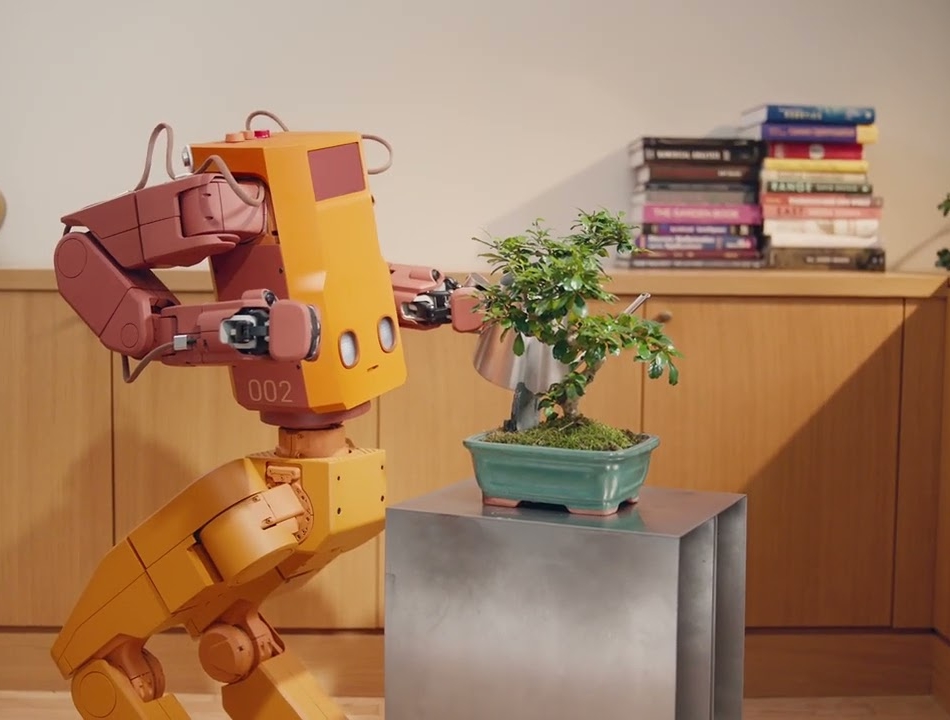
Household robots have a design problem: they need to be useful around people without looking as though they are trying to become people themselves. New York-based Tuesday Labs is approaching that challenge with Voxel Series-1, a compact, semi-autonomous robot built to handle small domestic tasks, from watering plants to sweeping up crumbs. Its first version combines autonomous intelligence with teleoperation, placing it somewhere between a working household assistant and a technology still learning how to live alongside humans.
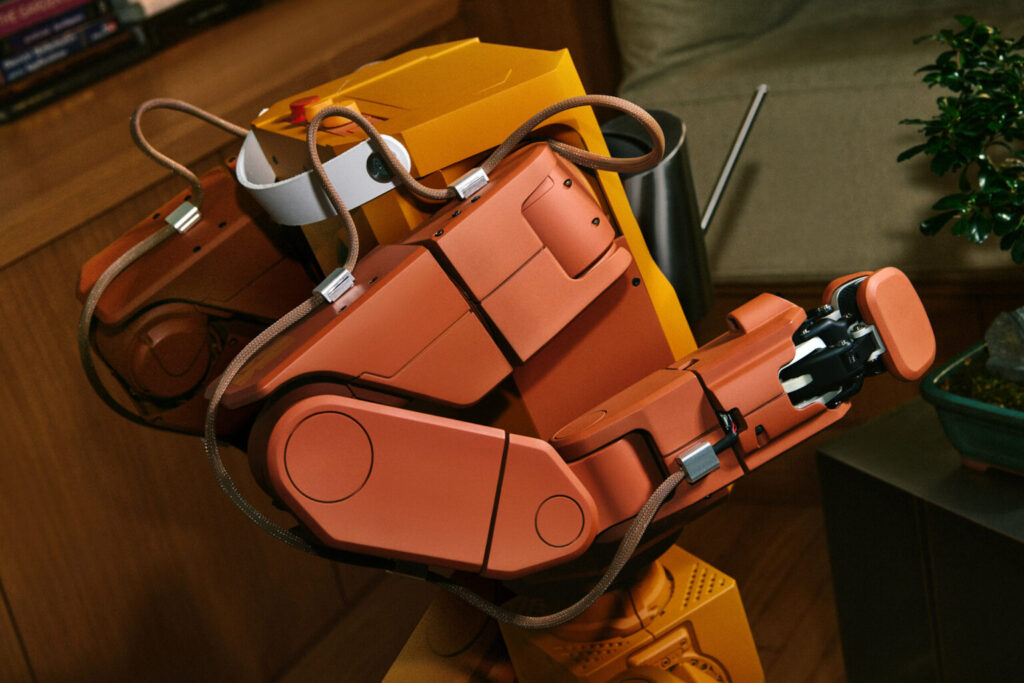
Founded in 2025 by former Boston Dynamics engineer Rosalind Shinkle, Tuesday Labs is developing robots intended to feel comfortable in everyday domestic environments. Voxel is the company’s first product, with a design that rejects the familiar humanoid template in favour of a small, cuboid machine with a colourful matte plastic shell, LED eyes and simple one-degree-of-freedom grippers in place of hands.
The design process began with familiar objects found around the home. Lamps, chairs and briefcases informed early concepts, Shinkle explained. The final character took shape through a collaboration with Alonso Martinez, a former Pixar character designer, bringing industrial design and character development into the same process.
The result is a machine that occupies roughly counter height, with a deliberately limited set of physical gestures. Its appearance communicates a specific role: a domestic droid designed to help with chores, rather than a mechanical imitation of a human housekeeper.
Designing a Robot People Can Read
Avoiding the uncanny valley was a central consideration throughout Voxel‘s development. The term describes the discomfort people can experience when an artificial figure looks almost human without convincingly reproducing human appearance or behaviour. Tuesday Labs has opted out of that territory altogether.
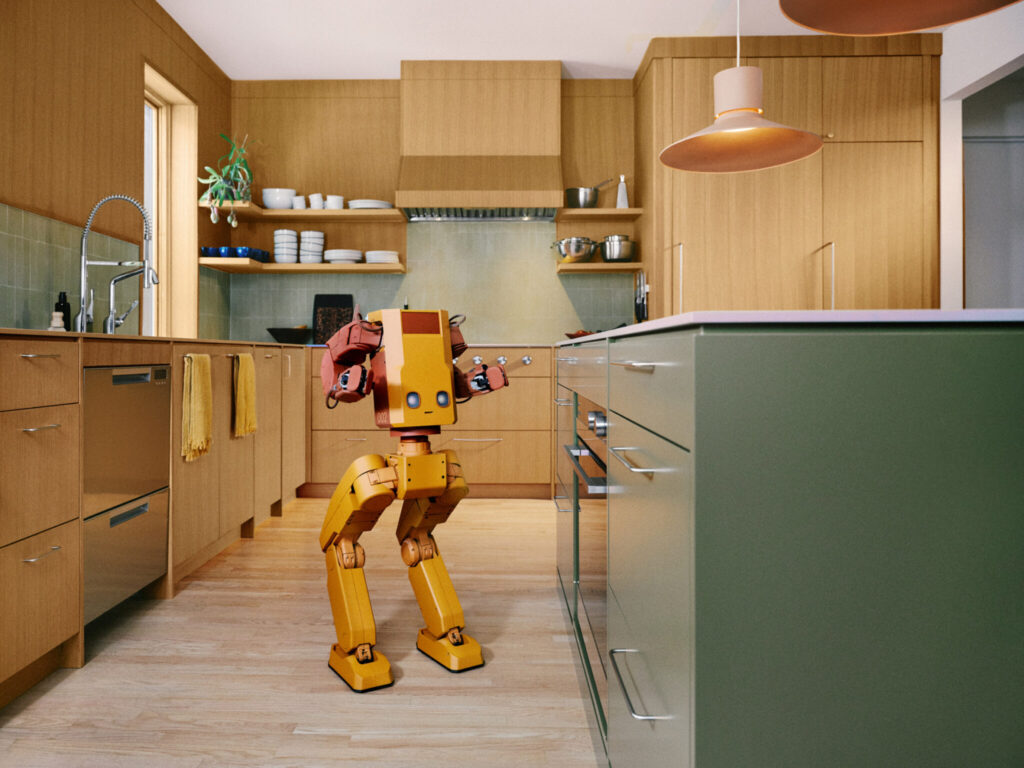
“We deliberately didn’t build a humanoid,” said Shinkle. The aim was to keep Voxel small and recognisably mechanical, giving it the character of a droid butler rather than something intended to occupy a human-shaped space in the home.
Five principles guided the design: domestic integration, maximalist visual expression, simplicity, luxury and playfulness. The colourful exterior and expressive eyes give the robot a distinct identity, while its compact proportions help establish how it fits into a household.
An important part of this approach is what Shinkle calls “affordance matching”: the relationship between what a machine appears capable of doing and what it can actually accomplish. A robot’s physical form can establish expectations before it performs a single task. When those expectations are realistic, users have a clearer understanding of its limitations and abilities.
Voxel‘s grippers, proportions and overall construction are intended to make its function legible. The design avoids suggesting a level of human dexterity that the machine cannot yet deliver. Its plastic shell also keeps the overall structure relatively lightweight, while the finish is intended to communicate the quality expected from a premium domestic product.
The Price of an Early Household Robot
Voxel‘s estimated price is $20,000, placing it firmly in the luxury technology market. Tuesday Labs plans to begin with a limited group of early adopters who will use the robot at home and help inform the development of its autonomous software.
This initial stage matters because domestic environments are unpredictable. Objects move, surfaces vary, routines change and seemingly simple chores require a machine to recognise its surroundings and respond appropriately. Combining autonomous systems with teleoperation allows Voxel to carry out tasks while the technology continues to develop through real-world use.
The robot runs on a rechargeable battery and returns to an at-home docking station as part of its regular routine. Tuesday Labs has not presented Voxel as a fully independent domestic worker; its current capabilities rely on both autonomous intelligence and remote human operation.
The company sees the high initial price as a starting point rather than the intended limit of the category. Shinkle’s longer-term ambition is to make household robots accessible to a much wider audience as the technology improves and manufacturing scales up.
A Robot Built Around Domestic Frustration
For Shinkle, the motivation behind Voxel is personal as well as technological. She has spoken openly about her dislike of cleaning her apartment and her desire to build something that could eventually take on repetitive household work. That frustration has become part of a broader question facing consumer robotics: which tasks are people genuinely willing to hand over to a machine, and what kind of machine would they welcome into their homes?
Tuesday Labs is betting on a design that makes the answer easier to imagine. Voxel‘s scale, colourful shell and limited physical vocabulary give it a recognisable presence without asking users to accept a simulated human being in their living space.
The company joins a growing field of developers working to bring general-purpose robots into domestic settings, where useful autonomy requires a combination of engineering, software development and careful attention to human behaviour. For now, Voxel remains an early-stage product with a premium price and a defined set of household functions.
Its larger ambition rests on a simple proposition: a robot should earn its place at home through the work it can do, while its design makes clear what people can reasonably expect from it.
Tuesday Labs online:
Website
Instagram
Photo/Video: (c) Tuesday Labs